
Acropolis History
5,000 Years on the Sacred Rock
From Neolithic settlement to UNESCO icon – trace the full story of the Acropolis of Athens, the monument that shaped Western civilisation and played a central role in ancient Greece. Renowned for its cultural significance, the Acropolis stands as a powerful symbol of Greek heritage and classical ideals.

Acropolis Timeline – From Bronze Age to Modern Day
Eight defining chapters in the life of Athens’ sacred hilltop.
| Period | Date | Key Events |
|---|---|---|
| Neolithic & Bronze Age | 4000-1200 BCE | First habitation on the rock; Mycenaean fortification walls and early shrine |
| Geometric & Archaic | 900-480 BCE | First stone temples to Athena; establishment as the city’s religious heart |
| Persian Destruction | 480 BCE | Xerxes’ army sacks Athens and burns every building on the hilltop |
| Classical Golden Age | 447-406 BCE | Pericles commissions the Parthenon, Erechtheion, Temple of Athena Nike, and Propylaea |
| Hellenistic & Roman | 322 BCE – 395 CE | Athens loses political power but keeps cultural prestige; Roman repairs and additions |
| Byzantine | 4th-15th c. CE | Parthenon converted into a Christian church dedicated to the Virgin Mary |
| Ottoman | 1458-1833 | Parthenon becomes a mosque; Venetian bombardment of 1687 devastates the structure |
| Modern Greece | 1834-Present | Restoration campaigns begin; UNESCO World Heritage status in 1987 |
The Acropolis of Athens – A History That Shaped the Western World
No single archaeological site tells the story of Western civilisation more vividly than the Acropolis of Athens. Rising 150 metres above the Attic plain on a slab of grey limestone, this flat-topped rocky hill has served as a fortress, a sanctuary, a religious center in ancient Athens, a symbol of democratic ambition, a church, a mosque, and – for the past two centuries – a monument to the idea that the ancient past still matters. Its buildings have been copied on every continent, its sculptures fought over by nations, and its name invoked whenever anyone reaches for an image of cultural greatness.
But the Acropolis was never frozen in a single golden moment. Its history stretches back roughly five millennia, and the hilltop that visitors see today is a palimpsest – layer upon layer of construction, destruction, conversion, and restoration, each period leaving its mark on the rock. Today, over three million people walk this ground every year – our Acropolis of Athens tickets page helps you join them.
Neolithic Beginnings & the Mycenaean Fortress
Archaeological evidence shows that people were living on the Acropolis rock as early as the fourth millennium BCE, marking the early history of the site. The Acropolis is a rocky plateau that rises 156 meters above the Attic basin. The hilltop’s natural advantages – steep cliffs on three sides, a freshwater spring on the northwest slope, and commanding views of the surrounding plain – made it an obvious site for early settlement. Pottery shards, tool fragments, and traces of simple dwellings from the Neolithic period have been found cut into the bedrock near the summit..
By the Late Bronze Age (roughly 1600-1200 BCE), the Acropolis had become a Mycenaean citadel. During the Mycenaean Era (1600–1100 BC), a royal palace protected by Cyclopean stone walls was constructed on the Acropolis. A massive fortification wall – fragments of which survive beneath the later classical structures – enclosed a palace complex at the summit. This wall, built from enormous limestone blocks in the characteristic Mycenaean “Cyclopean” style, stood up to six metres thick in places. A concealed stairway cut through the rock led down to a natural spring, ensuring the fortress could withstand a siege.
Mycenaean religion appears to have been practised here as well. Small cult objects and votive offerings suggest that the hilltop already functioned as a sacred precinct centuries before the first stone temple to Athena was raised.
The Archaic Period – First Temples to Athena
As Athens emerged from the Greek Dark Ages (roughly 1100-800 BCE), the Acropolis gradually transitioned from a military fortress into a sacred religious center dedicated to Athena Polias during the Archaic Period (800–480 BC). By the Geometric period (circa 900-700 BCE), the cult of Athena – Athens’ patron goddess and patron deity – had become firmly established on the hilltop, and the first simple altar and shrine were erected on the site where the Parthenon would eventually stand. The Acropolis thus became a major religious site, central to the spiritual and civic life of ancient Athens.
The earliest substantial temple – sometimes referred to by scholars as the “Bluebeard Temple” after a triple-bodied monster that decorated its pediment – dates to around 570-550 BCE. Built from local limestone and decorated with brightly painted sculpture, it represented Athens’ growing ambition and wealth during the Archaic period. A second, larger temple to Athena – the “Old Temple of Athena” or Archaios Neos – was constructed nearby around 525 BCE, possibly under the tyrant Peisistratos or his sons. This temple replaced an earlier structure that was partly destroyed, reflecting the ongoing development and renewal of the Acropolis as a religious site.
Modern visitors imagine Greek temples as white marble, but archaeological evidence proves the opposite. Archaic and Classical buildings on the Acropolis were painted in vivid reds, blues, greens, and golds. Traces of pigment survive on sculptural fragments in the Acropolis Museum – a visit there fundamentally changes how you see the hilltop.
480 BCE – The Persian Destruction
The event that divides the Acropolis’ history into “before” and “after” came in September 480 BCE, when the Persian king Xerxes occupied an evacuated Athens and systematically destroyed every building on the sacred rock. The Archaios Neos was burned, the columns of an unfinished marble temple (the “Older Parthenon”) were toppled, and votive statues were smashed or buried.
The destruction was total, but it also created the conditions for the masterpieces that followed. The Athenians reportedly swore an oath never to rebuild the ruined sanctuaries, leaving them as a memorial to Persian sacrilege. Whether or not that oath was real, the hilltop remained largely in ruins for more than thirty years – until one man decided to turn catastrophe into the greatest building programme the ancient world had ever seen.
The Classical Golden Age – Pericles and the Parthenon
In the mid-fifth century BCE, the Athenian statesman Pericles launched an ambitious building programme that stands as the most significant public construction effort in Greek history. Drawing on the wealth of the Delian League – the anti-Persian alliance whose treasury Athens had controversially moved to the Acropolis – he commissioned a sequence of major temples and structures that would redefine classical architecture, sculpture, and civic identity for millennia to come.
Together, these four major temples formed a carefully orchestrated architectural sequence. Visitors arriving through the Propylaia experienced a calculated series of reveals – the Athena Promachos bronze statue straight ahead, the Parthenon dominating the skyline to the right, the Erechtheion to the left, and the Temple of Athena Nike glinting on the bastion behind them. Every sightline, every proportional relationship, was deliberate, exemplifying the ideals of classical architecture.
The Periclean building programme employed thousands of skilled workers – stone masons, sculptors, painters, carpenters, metalworkers – and took nearly four decades to complete. Its cost was enormous, and Pericles faced sharp political criticism for diverting League funds to glorify Athens. But the result was a hilltop sanctuary that became the physical embodiment of Athenian democracy, artistic genius, and civic pride.

Hellenistic & Roman Athens – Cultural Capital Without Political Power
After the Peloponnesian War (431–404 BCE) and the subsequent rise of Macedon under Philip II and Alexander the Great, Athens lost its military and political dominance. However, during the Hellenistic period, the city continued to thrive as a center of culture, philosophy, and scholarship, maintaining its intellectual prestige. The Acropolis remained the city’s most prestigious sacred precinct, and repairs and modifications were made to the existing buildings and acropolis walls to preserve their significance. Other buildings and monuments on the Acropolis, beyond the main temples, were also constructed or altered during the Hellenistic and Roman periods, contributing to the site’s rich architectural diversity.
When Rome absorbed Greece into its expanding empire, the Acropolis entered the Roman period, marked by renovation, repurposing, and new construction. Roman emperors, eager to associate themselves with Greek culture, funded repairs and additions to the Acropolis and its existing buildings. Augustus erected a small circular temple dedicated to Roma and Augustus just east of the Parthenon. Emperor Hadrian, a passionate philhellene, sponsored major building projects across Athens in the second century CE, though his most conspicuous monument – the enormous Temple of Olympian Zeus – stood in the lower city rather than on the hilltop.
The Acropolis continued to play important roles throughout history, serving as a Christian church during the Byzantine period, a mosque during Ottoman rule, and later as a symbol of Greek heritage following the War of Independence in the 19th century.
In 1801–1805, Lord Elgin, British ambassador to the Ottoman Empire, removed roughly half the surviving sculptural decoration from the Parthenon and shipped it to London, where it has remained in the British Museum ever since. Greece has formally requested the marbles’ return for decades. The debate – involving questions of ownership, cultural heritage, preservation, and colonial history – remains one of the most contested in the museum world.
The Byzantine Period – From Temple to Cathedral
The transition from pagan sanctuary to Christian worship happened gradually over the fourth and fifth centuries CE. As Christianity became the official religion of the Roman Empire under Theodosius I, the old temples across the Mediterranean were either destroyed, abandoned, or converted. The Acropolis was no exception.
By roughly the sixth century CE, the Parthenon had been converted into a church dedicated to the Virgin Mary (Theotokos). The conversion involved significant alterations: the eastern entrance was walled up, an apse was added at the eastern end, Christian frescoes were painted over the ancient metopes, and the chryselephantine statue of Athena – long since vanished – was replaced by a Christian altar. Despite these changes, much of the Parthenon’s classical structure survived the conversion remarkably intact.
The Erechtheion and the Propylaea were also adapted for Christian use. The Erechtheion served as a church, and parts of the Propylaea were incorporated into the residence of the local bishop. For nearly a thousand years, the Acropolis functioned as a major pilgrimage site and a seat of Christian authority in Athens.
Ottoman Rule – Mosque, Fortress, and Catastrophe
When the Ottoman Turks captured Athens in 1458, the Acropolis entered yet another phase of transformation. The Parthenon was converted into a mosque – a minaret was added to the southwest corner – and the Erechtheion became the harem of the Ottoman military commander. The hilltop was fortified and garrisoned, and access was restricted to the Turkish military and administration.
For more than two centuries, the Parthenon-mosque survived in relatively good condition. But on the evening of 26 September 1687, catastrophe struck. A Venetian army under Francesco Morosini was besieging Ottoman-held Athens, and a mortar shell scored a direct hit on the Parthenon, which the Ottomans were using as a gunpowder magazine. The resulting explosion blew out the entire central section of the building, destroyed twenty-eight columns, and scattered marble fragments across the hilltop.
The damage was irreversible. What had survived 2,100 years of use, conversion, and weathering was shattered in a single night. When the Venetians briefly occupied the Acropolis, Morosini attempted to remove sculptures from the west pediment as trophies – only to drop them, shattering them on the rock below.

The Modern Era – Independence, Restoration, and Global Symbol
The Greek War of Independence (1821–1829) brought the Acropolis back into Greek hands, though not without further damage from fighting around and on the hilltop. Today, the surviving remains – including the Parthenon, Erechtheion, and Temple of Athena Nike – stand as powerful symbols of Greece’s cultural heritage and ongoing preservation efforts. When Athens was declared the capital of the new Greek state in 1834, the Acropolis was immediately recognised as the supreme symbol of national identity. Ottoman and medieval structures added to the hilltop were systematically removed, and the first archaeological excavations began in earnest.
Major restoration campaigns have punctuated the modern era. In the late nineteenth century, the Greek architect Nikolaos Balanos undertook ambitious structural repairs – re-erecting fallen columns, replacing rusted iron clamps, and stabilising walls. However, some of Balanos’ techniques, particularly his use of iron reinforcements that corroded and cracked the marble, later caused problems that twentieth-century conservators had to address.
The Acropolis suffered significant damage during the 1687 siege by the Venetians, when the Parthenon, used as a gunpowder magazine, was struck by artillery fire, resulting in severe destruction. Other periods of conflict and siege throughout history also contributed to the turbulent preservation of the site.
Since 1975, the Acropolis Restoration Project, led by the Committee for the Conservation of the Acropolis Monuments (ESMA), has worked to reverse the decay caused by pollution, military actions, and previous misguided restorations. This painstaking, ongoing restoration has included the use of titanium clamps, laser cleaning, and careful replacement of damaged blocks with fresh Pentelic marble from the same quarries the ancients used. A total of 2,675 tons of architectural members have been restored, with 686 stones reassembled from fragments of the originals, 905 patched with new marble, and 186 parts made entirely of new marble. Restoration of the Temple of Athena Nike was completed in 2010, using titanium dowels designed to be completely reversible for future modifications. The work is expected to continue for decades – a slow, meticulous process that treats each stone as an irreplaceable piece of human heritage.
Key Monuments on the Acropolis
Four main structures define the hilltop that visitors experience today, each distinguished by unique architectural elements such as columns, friezes, and sculptural details. Built during the Periclean programme of the fifth century BCE, these monuments represent distinct aspects of Athenian religion, architecture, and artistic achievement.
The Acropolis also hosted the Panathenaic Festival, a grand religious celebration where citizens presented a sacred robe to Athena Polias, further highlighting the site’s religious and cultural significance. Today, the Acropolis remains a testament to the enduring legacy of ancient Athens — embodying the educational value of classical ideas, art, and culture, while serving as a bridge connecting the past with the present and future.
Experiencing History — Audio Guide vs. Live Guide
How you absorb 5,000 years of history depends on the kind of experience you want. Both approaches have genuine advantages.
The Acropolis Museum — The Other Half of the Story
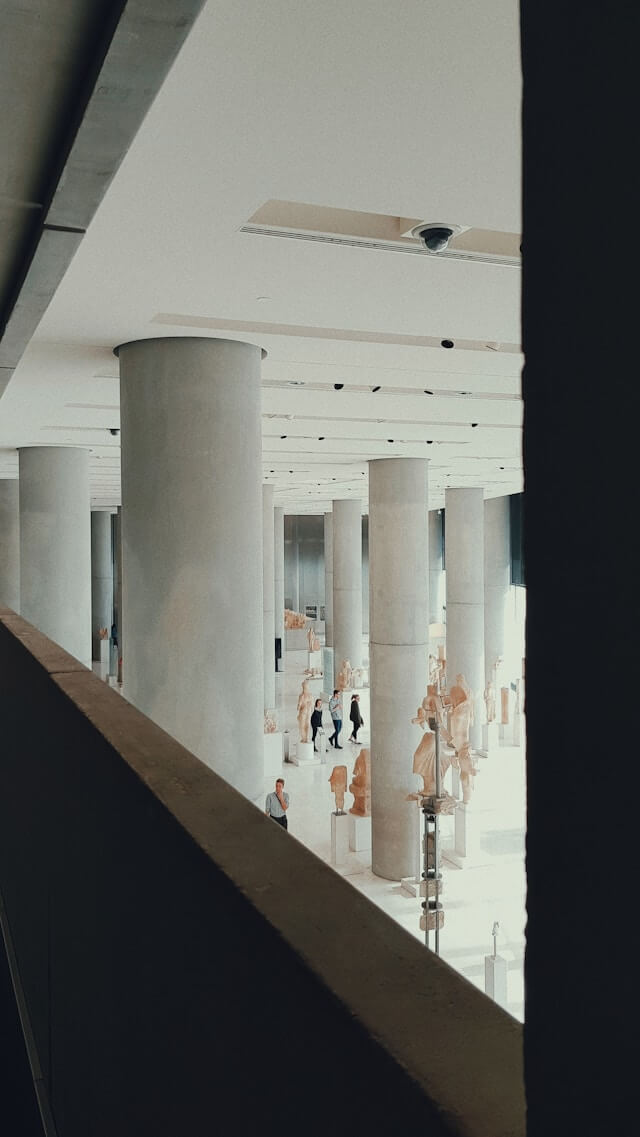
No visit to the Acropolis is complete without its companion museum, situated 300 metres south of the hilltop at the foot of the slope. Designed by Swiss-American architect Bernard Tschumi and opened in 2009, the Acropolis Museum houses approximately 4,000 artefacts recovered from the site — from Mycenaean pottery and Archaic marble maidens (korai) to the surviving panels of the Parthenon frieze.
The museum’s top floor is oriented to align precisely with the Parthenon visible through its glass walls. Here, the original frieze panels alternate with plaster casts of the sections held in London – a visual argument, made in marble and plaster, for the reunification of the sculptures. Whether you take a side in that debate or not, the presentation is extraordinary. A combined ticket covering both sites saves money – see all Acropolis combo tickets for current options.
Visiting the Acropolis — Practical Details
Understanding the history enriches the visit, but a few practical facts help you plan around it.
Best Acropolis Tickets for 2026
All tickets from verified, top-rated providers — compared in one place.

Acropolis & Parthenon Tickets with Audio Guide
Skip the ticket lines and explore at your own pace with a multilingual audio guide covering every major monument on the hill.

Acropolis & Parthenon Guided Tours with Entry Tickets
Explore the Acropolis with an expert guide who brings ancient history to life. Small groups, headsets for clear audio, and plenty of time for questions and photos.
Acropolis + Acropolis Museum Tickets with Audio Guide
The two essential Athens experiences in one booking. Timed entry to the hilltop and skip-the-line Museum admission, both with audio guides.

Athens Multipass: Acropolis + 5 Archaeological Sites with Audio Guide
The best-value pass in Athens — one ticket covers the Acropolis and five major archaeological sites, all with multilingual audio guides. Valid for 3 days after first entry.
Plan Your Visit to the Acropolis
April 1 – September 15: 8:00 AM – 7:30 PM
September 16 – 30: 8:00 AM – 7:00 PM
October 1 – 15: 8:00 AM – 6:30 PM
October 16 – 31: 8:00 AM – 6:00 PM
November 1 – March 31: 8:00 AM – 5:00 PM
Last entry: 30 min before closing. Closed: Jan 1, Mar 25, Easter, May 1, Dec 25-26.
By Metro: Acropoli (Line 2) is nearest — 4 min to southeast gate, 8 min to west gate. Monastiraki (Lines 1 & 3) and Thiseio (Line 1) also work.
Main entrance: West slope via Theorias Street.
Side entrance: Southeast, on Dionysiou Areopagitou — often shorter lines.
By bus: Lines 230, 035, 040, 227. Hop-on hop-off stops at Acropolis Museum.
Time of day: 8:00 AM at opening or after 5:00 PM — fewer crowds, better light.
Season: April – mid June and mid September – October for ideal conditions.
Avoid: Weekends 10 AM – 2 PM, especially July-August (35°C+).
West (Propylaea): Classical approach through the monumental gateway. Wider path, elevator access, guided tour meeting point. Busier queues.
Southeast (Dionysus): Beside the Theatre of Dionysus, near the Museum. Shorter waits, steeper climb, designated for skip-the-line tickets.
Bring water — refill stations available, no cafés on-site.
Wear shoes with good grip. Marble paths are slippery, especially after rain.
Budget 2-3 hours for the hill + 1.5-2 hours for the museum.
Photography allowed everywhere. Tripods and drones need advance permission.
No re-entry once you leave. Complete your entire visit before exiting.